Showing posts with label hong kong. Show all posts

Monday, May 4, 2009

HUNGER STRIKE


After spending what seemed like hours chopping, slicing and cooking in the kitchen, I proudly served up yet another banquet to my Gorgeous Girl (GG) which in my mind would have been fit for Great Empress Wu when I heard shrieks of disgust, "Why can't we eat NORMAL food... I am soooo SICK of CHINESE food?" I paused for a moment and then with a smile on my face replied, "BUT GG this IS normal food as can I remind you that we DO live in CHINA!" Well, this comment did not go down well at all and in fact there was an outright protest in our household that night. GG decided that until I cooked some NORMAL FOOD that she would go on a hunger strike (even though it only lasted a matter of an hour).

OK so not everybody is as keen about Chinese food as I am - point taken. GG, I will try to cook more NORMAL FOOD even though I think that it is a bit of WESTERN STODGE and I pay FOUR times the amount for GWEILO STUFF but to appease you I will include a bit of this and a bit of that on my blog - albeit a bit more GOURMET.
Copyright © 2008 - 2009 All Rights Reserved

Sunday, May 3, 2009

All Dressed Up & No Where To Go!

Somebody had an awful lot of fun playing dress-ups this afternoon and our little furry feline seemed most content in his snug new cardi.
Copyright © 2008 - 2009 All Rights Reserved

Saturday, May 2, 2009

Dan Dan Mian


Dan Dan Mian

Ingredients:
1/2 tablespoon Sichuan peppercorns
200g minced pork
2 tablespoons light soy sauce
2 tablespoons peanut oil (for frying)
3 garlic cloves
2 tablespoons grated ginger
4 spring onions finely chopped
2 tablespoons fine peanut butter
1 tablespoon finely chopped peanuts
2 tablespoons light soy sauce
1 teaspoon chili oil
2 tablespoons Chili Bean Sauce (Toban Djan)
1 dried Sichuan chili finely sliced
1 tablespoon rock sugar
Juice of half a lime
1 1/2 cups of fresh chicken stock
1 Catty (600 gm) Fresh Noodles

Method:
  1. Grind the Sichuan peppercorns in a mortar and pestle then dry fry in a wok until fragrant.
  2. Marinate the pork in 2 tablespoons of the soy sauce whilst you prepare the other ingredients then stir fry the pork in the peanut oil until brown and crispy. Remove from the wok and drain.
  3. Add the spring onion, ginger and garlic to the wok and stir-fry for approx. 30 seconds then add remaining ingredients. Simmer until the sauce is reduced and the sauce darkens in colour approx. 2 - 4 minutes.
  4. Cook the noodles in salted boiling water for 2-3 minutes, then drain and divide between four bowls.
  5. Ladle the peanut sauce over the noodles, garnish with fresh herbs and a sprinkle of crushed peanuts. Serve.
Copyright © 2008 - 2009 All Rights Reserved

Wednesday, April 29, 2009

Chinese Knotting - Shrimp & Dragonfly Guild


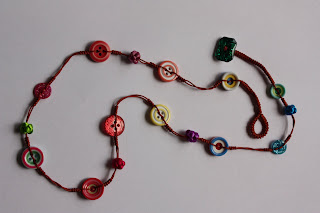
Over the last week, I've been busy designing my latest Chinese knot necklace, which I showcased at the Shrimp & Dragonfly Guild today. A bit of button bling with with lots of colour!

And, afterwards I designed a simple lariat necklace using neon colours from current fashion trends.

Click on the title to this post to find out about Chinese knot classes in Hong Kong.
Copyright © 2008 - 2009 All Rights Reserved

Wednesday, April 1, 2009

Chan Chi Kee - Chinese Cleavers & Restaurant Quality Equipment

Yesterday, I went to my favourite street in Yau Ma Tai to get a couple of restaurant grade Chinese cleavers. One of the best shops in the street is Chan Chi Kee Cutlery, G/F 316-318 Shanghai Street, Kowloon Hong Kong www.chanchikee.com email: info@chanchikee.com

If you visit their website you will notice that shopping for Chinese cleavers is serious business as there is not one or two to choose from but a whole catalogue! Well looked after your Chinese cleaver should last many years, just remember to wash it straight away after use, apply a smear of oil and store it in a safe place.

If you are going to use a whet stone to sharpen your cleaver, soak it in water for 20 minutes then sharpen both sides of the blade at a 30-35 degree angle. If you sharpen the stone 10 times on one side then this is how many times you need to do it on the other side. If you accidently chip your cleaver whilst chopping, then sharpening is going to take considerably longer. Note: Chan Chi Kee Cutlery Co. Ltd delivers worldwide and also have a huge range of other restaurant quality items including but not limited to pastry making, baking, dim sum, moulds, woks, strainers, skimmers and ladles etc.
Copyright © 2008 - 2009 All Rights Reserved

Saturday, March 28, 2009

Learn Mandarin with FM S.H.E 11th Album

Living in Hong Kong, I would love to be able to speak Cantonese but find the tones a little too difficult to master so have embarked on learning a bit of Mandarin instead. Problem is that I don't get to listen to people speaking the language often enough, so to hone my skills I've started to listen to some mandopop.

Currently, I enjoy the latest album produced by FM S.H.E. The music is modern, the tunes catchy and there is also a take on Michael Jackson's "Billy Jean". Interspersed in the lyrics is also a bit of rap which adds another dimension.

Although, the video isn't that great you can listen to a track called "Miss Universe" if you click on the title to this post and who knows, you might be singing in Mandarin sooner than you think.
Copyright © 2008 - 2009 All Rights Reserved

Thursday, March 26, 2009

Cabbage & Pork Dumplings

Today, I went to one of my favourite Chinese dumpling haunts for brunch of Cabbage and Pork Dumplings. Whilst there I watched one of the young chefs make the dumplings. A dough of tang flour (rice flour) and water is rolled into a thin snake like shape and then cut into about 1.5cm lengths. Each length is then flattened with the palm of one hand then rolled with a thin dim sum rolling pin. After the dumpling wrapper is formed, the dough is cupped in one hand and a small flat dim sum spatula is used to insert the filling in the middle. The hand holding the wrapper is then cupped to close the dumpling then it is pleated with the thumbs of both hands. The chef making the dumplings was extremely fast and apparently many Chinese are taught this method of making dumplings when they are small children. I also asked if the chef added cold water to the boiling water each time they are cooked but he said that this is an old method which is used when you can't control the cooking temperature. The water in the restaurant was temperature controlled so this method wasn't required.
Copyright © 2008 - 2009 All Rights Reserved

Hong Kong Style Mango Pudding

Note that the measurements below do not contain any typos as they are derived from the Chinese Tael and Catty weight system.

Ingredients:
300g mango, diced
150g mango puree
150g soya bean milk
150g fresh cream
300g ice cubes

Gelatine Syrup
450g water
26g gelatine powder
225g sugar

Method:
In a saucepan over a low heat dissolve all of the ingredients for the gelatine syrup, remove from heat and pour into a large bowl. Add the soya bean milk and fresh cream and mix well. Add the diced mango and the diced mango puree and combine. Lastly, add the ice cubes stirring until the ice cubes have melted. Pour into pudding moulds and chill to set.

You can buy really cool pudding moulds and dim sum equipment from the many kitchenware shops that line Shanghai Street. I normally visit Man Kee Chopping Board, G/F, 341-343 Shanghai Street, Yau Ma Tei, Kowloon, Hong Kong.
Copyright © 2008 - 2009 All Rights Reserved

Wednesday, March 25, 2009

The Old Streets of Sai Kung


In the old streets of Sai Kung I discovered a little shop called "Wo Cheong Hou" located on the G/F No. 14 Main Street Sai Kung, New Territories. Inside, perched on a stool, sat a little old man called Mr Mak who is one of the last remaining iron mongers in Sai Kung if not Hong Kong. Displayed proudly all over one wall were photo's of Margaret Thatcher, her entourage and Mr Mak when she had last visited his shop. Out front were Mr Mak's hand made buckets, watering cans, metal boxes and the like and towards the back an assortment of mail boxes.

On Hong Kong island I normally find that the locals are quite reluctant for me to take their photo but when I asked Mr Mak he immediately straightened his back, adjusted is glasses and obligingly struck a pose. Mr Mak absolutely made my day! And, I have to say that I felt very honoured to be able to take his photo as I was not only capturing a remarkable man but also a part of Hong Kong's history. Mr Mak is 93 years old, still works very hard and credits his good health to his diet and exercise. He explained that there aren't too many products on the market like his anymore because the youth of today aren't interested in learning a trade that's not profitable enough. So after spending a lovely half hour with Mr Mak and one of his neighbours I proudly walked away with a smile on my face and my shiny new mailbox tucked under my arm.

Next stop down the street and around the corner was a little tea shop called "Tea & Zen". Here I spent a good couple of hours talking to Raymond and his wife Debbie (the owners), Clarence and Maria. I learnt what I was doing wrong when I was making my pu-erh (bolay) tea and I also received a Cantonese language lesson. We then talked a little about global politics, cultural differences and photography all the while sipping our pu-erh. Then, much to our delight and unbeknown to us, Maria had visited one of the street stalls and had come back with brown paper bags full of Chinese egg puffs, which were absolutely delicious. It was a wonderful afternoon and I walked away with some pu-erh tea to replenish the stock in my cupboard. Must remember to put 5 gm pu-erh in a small teapot (10 gm for a larger one) and to flush the tea leaves twice before steeping in boiling water. After the tea has steeped for about 30 seconds you can then pour the tea into a glass jug and leave the tea leaves dry in the pot until you are ready to make more tea. You can do this up to about ten times at one sitting before disposing of the tea leaves.
Copyright © 2008 - 2009 All Rights Reserved

Saturday, March 21, 2009

Yuen Yick Oyster Sauce & Shrimp Sauce Manufacturer Peel Street

Luckily, I visited Yuen Yick Oyster Sauce & Shrimp Sauce Manufacturer just as some shrimp sauce was being bottled. I can't speak Cantonese but it looked like father and son were bottling the sauce.


Monday, March 2, 2009

Magically Transformed

Before & After

This is what happens when you ask a lovely Chinese lady in a jewellery store in Hong Kong feedback about how to attach a pendant to your Chinese Knot necklace. Much better don't you think?
Copyright © 2008 - 2009 All Rights Reserved

Necklaces, Necklaces, Necklaces


With busy hands I am now spoiled for choice in the jewellery department.
Copyright © 2008 - 2009 All Rights Reserved

Thursday, February 26, 2009

Tassel Done & Dusted


OK, done and dusted - the tassel was a bit tricky and I changed the design a bit but I'm happy with the result. The last photo that I posted for this didn't do this gorgeous tassel justice so here goes again.
Copyright © 2008 - 2009 All Rights Reserved

Saturday, February 21, 2009

How to Finish this Design?

After our lovely shopping expedition to Hung Hom on Friday 20 February 2009 with D'Arcy and Jamila, I created this decoration but just now need to finish it off.
Copyright © 2008 - 2009 All Rights Reserved

Thursday, February 19, 2009

Lin Heung Tea House Cooking Demo

Chicken with Preserved Black Beans

Yesterday, Wednesday 18 February 2009 I experienced a rare opportunity to watch a chef from the Lin Heung Tea House demonstrate three dishes i.e. Pork Cartilage in Special Sauce; Beancurd with Minced Pork and Black Olives; and Chicken with Preserved Black Beans. The cooking demonstration was held at the Towngas Cooking Centre in Causeway Bay.

Lin Heung Tea House, 160-164 Wellington Street, Central is a famous Hong Kong dim sum establishment that has withstood the test of time and is believed to be between 85-100 years old. Of all the tea houses that have existed throughout Hong Kong's history only two remain in operation today, namely the Lin Heung Tea House and the more up market Luk Yu Tea House.

There are plenty of websites that go into dim sum etiquette and descriptions about the Lin Heung Tea House but few if any other recipes on the internet from this tea house. The recipes provided by Towngas were very basic and lacked essential information but with excellent translation/s throughout the cooking demonstration, I was able to compose fairly detailed instructions for each dish.


Chicken with Preserved Black Beans

Ingredients:

1 fresh chicken not previously chilled if possible cut into 2 cm pieces

3 cloves garlic minced

3 tael (80 gm) shallots (small brown ones)

2 tael (80 gm) Pearl River Bridge preserved black beans with ginger

Enough red chili and green pepper for colour and according to taste (chopped)

1 tablespoon cornstarch

50 ml water

Seasonings:

2 teaspoons oyster sauce

1 teaspoon light soy sauce

1 teaspoon sugar

Drizzle of dark soy sauce for colour

A little salt

Method:

  1. Pat chicken pieces with cornstarch and toss well with fingers until well combined.
  2. Blanch the chicken in oil. Heat 3 tablespoons of oil in a wok, swirl oil around and then when hot add the chicken pieces. Continuously move the chicken around and up the sides of the wok using a medium heat (not high). Using a towel, hold the side of the wok handle, pick up the wok and swirl. You will notice that as the chicken blanches it starts to develop a golden crust. When blanched remove from wok.
  3. Sauté the shallot, garlic and preserved black bean, red chili and green pepper in the wok then add 50 ml water.
  4. Add chicken and fry well. Add a drizzle of dark soy for colour then add seasonings.
  5. Cook on low heat until the sauce is absorbed and the chicken dries out. Serve.

Tips:

  1. Chop chicken using the saw cutting and push cutting technique so that you have approx. 2cm chicken pieces with bone in. The only bone you need to remove is the thigh bone. To do this slice along the leg bone then using the push cutting technique cut the bone nearest where the chicken’s foot would have been then pull the thigh bone out to remove.
  2. In a restaurant, the chef would blanch the chicken in quite a bit of oil but for home use only 3 tablespoons of oil is required. Note that it is important to continuously move the chicken around in the wok.
  3. Important to make the chicken dry with not much sauce so that the flavour is good.
  4. Whole chicken can be replaced with chicken breast.
  5. No need to cook with lid on wok.
  6. Add enough red chili and green pepper according to taste.

Beancurd with Minced Pork and Black Olives

Ingredients:

1-2 packs silken tofu (tofu for steaming)

4 pieces preserved black olives cut roughly but not minced

6 tael (240 gm) raw minced pork blanched until cooked

3 cloves garlic minced

Approx. 2 small red chillies diced

Seasonings:

2 teaspoons oyster sauce

1 teaspoon sugar

½ teaspoon cornstarch

Method:

  1. Open tofu packets and drain off liquid. Slice tofu and arrange on a plate or platter.
  2. Mix well oyster sauce, sugar and cornstarch. Stir in black olive, minced pork, garlic and chilli. Place the mixture on top of the tofu.
  3. Steam for 5 minutes, serve.
Tips:
  1. Each packet of tofu was slightly bigger than a 250 ml rectangle tub of butter. Each packet of tofu when sliced thickly yielded 8 slices. Make sure that you drain the tofu really well before adding the seasoning, pork and olives to prevent the tofu becoming watery. If you sprinkle salt over the tofu when you remove it from the packaging water will seep out straight away and you can drain this off before continuing with the recipe.
  2. Olives are preserved and are not the western variety. Packets can be bought from Asian grocery stores or again from the Hong Kong wet market/s.
  3. Unlike the pork cartilage, blanch the minced pork in hot water until cooked. The chef had already done this and had stored the very dry mince in a plastic container. Make sure that after you blanch the pork mince that you use a sieve to drain the meat until it becomes dry.


Pork Cartilage in Special Sauce

Ingredients:

1 catty (600 gm) pork cartilage (ends of ribs are best as they contain nice fat, size of each piece was approx. 1.5 cm)

2 tael (40 gm) fresh ginger (optional) this is in addition to other spices below

Seasoning:

1 x 450 ml bottle Amoy All Purpose Marinade

35 gm rock sugar (more if you are making your own marinade as the All Purpose Marinade is sweeter)

Spices:

7-8 bay leaves (dried)

2 cardamom pods

5-6 licorice roots (slices dried)

4 spicy sand ginger (dried)

Method:

  1. Blanch pork cartilage until you can see all the scum/dirt coming off. Make sure that when you blanch the pork cartilage that you put it in the saucepan on the stove with cold water as this prevents the pork from cooking - as would be the case if you had blanched the pork in boiling water. Remove pork and drain.
  2. Place pork cartilage in a clay pot, pour in half the bottle (approx. 225ml) of the Marinade, add 350ml water, spices, ginger (optional) and rock sugar.
  3. Bring to boil then simmer on low heat with lid on for 1.5 hours then serve.

Tips:

  1. The Amoy All Purpose Marinade is strong so it needs to be diluted with water.
  2. The special secret is to add 2 tablespoons of white vinegar to the clay pot when the pork cartilage is simmering as this will speed up the cooking process and reduce the cooking time by approx. 30 minutes.
  3. When blanching the pork cartilage, put cold water in the saucepan, add the meat then bring to the boil or the meat will cook first if put into boiling water and become tough.
  4. Continue to check the pork as it is simmering; if the clay pot becomes dry add more water.
  5. To check tenderness, insert a chopstick into the pork and if it goes right through then it is tender and ready to be served.
  6. The pork cartilage can be replaced with chicken wings (no need to add vinegar as chicken cooks more quickly than pork).
  7. After you cook the pork cartilage you can keep the marinade and re-use it a few more times (similar to a master sauce/ lu stock).
  8. To make your own marinade for this recipe use a mixture of light and dark soy sauce with spices and sugar instead of using the All Purpose Marinade. Combine 100 ml normal soy sauce (light), 150 ml premium strong and sweet flavoured soy sauce, 200 ml water, approx. 35 gm rock sugar (more depending on taste), 4 teaspoon of caster sugar, 1 tablespoon oyster sauce and the spices listed above.
  9. If you have difficulty buying the spices for the marinade you should also be able to buy them already made up from the wet market (Hong Kong) or Asian grocery stores. The “Marinade Stuff” I bought from Choi Hop Lee, Condiments and Asiatic Products, G/F 4 Bowrington Road Wanchai HK also included star anise, cassia bark, cloves, dried tangerine peel and white peppercorns in addition to bay leaves, cardamom pods, licorice root and sand ginger.
  10. Note that rock sugar and caster sugar have different flavours.
My absolute favourite was the Pork Cartilage in Special Sauce and then the Chicken with Preserved Black Beans.


Photo of Spices - top left bowl contains blanched minced pork and the bottom left bowl contains the preserved olive. The loose spices are bay leaves, licorice root and dried sand ginger.

Copyright © 2008 - 2009 All Rights Reserved

Tuesday, February 17, 2009

Mahjong

Today, I met up with some of my class mates from the YWCA to play a few rounds of Hong Kong style mahjong.

None of us had played since before Christmas so we were all a bit rusty.  Just glad that we weren't playing for money as I would have had very deep pockets by the afternoon.

Just a little bit potty!


Here is the gorgeous little Chinese knot teapot that I made! Took quite a while to make (considering it was my first attempt) and was a tad tricky in parts but got there in the end. I haven't had time to put a little button knot on the lid but I'll get to that later.
Copyright © 2008 - 2009 All Rights Reserved

Sunday, February 15, 2009

Chinese Tea Pots

On Monday 16 February 2009 I am off to visit the founder of the Shrimp and Dragonfly Guild of Hong Kong to learn how to make a Chinese Knot Tea Pot. We'll have a few laugh's about expat musings and will then probably tie our fingers up in knots. Should be lots of fun and I hope to provide a photo of the result.

Monday, February 9, 2009

Modern Times Exhibition Macau


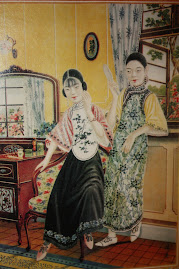
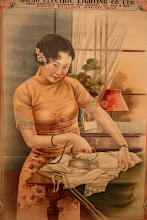
On 5 February 2009, I travelled to Macau to visit the Modern Times Exhibition at the Museum of Art.  Here's a glimpse of some of the wonderful advertising posters that were on display.

"... In 1904 - the 30th year of Emperor Guangxu's reign - China imported a chromatic printing machine to mark the beginning of China's colour printing industry.

In terms of graphic art, the "fashion girl" emerged as the star advertising performer.  Similar in nature to traditional Chinese paintings depicting beautiful women, this new commercial vehicle of graphic art incorporated what was later to become the accepted standard for modern feminine beauty.  The 60-plus advertising paintings displayed in the exhibition were produced from the 1920's to 1940's..."  

The above information was extracted from 'What's On' No. 68 English Version 2/2009 Macau Government Tourist Office.

Tuesday, November 4, 2008

Lamma Island Hong Kong

Today, we visited Lamma Island which is the 3rd largest island in the territory after Lantau and Hong Kong Island.  From Hong Kong Island, we caught the ferry from Central Pier No. 4 to Yung Shue Wan, had a seafood lunch then walked along the 'Family Trail' towards Hung Shing Ye Beach.  After, stopping at the beach to admire the view, we continued to Sok Kwu Wan Pier where we caught the ferry back to Hong Kong island.   Had a great time but not so sure that the trail is suitable for families as it is quite steep in parts!